

Experienced SAP specialists prefer B2B. Is body leasing a remedy for changes in the National Labour Inspectorate?

More than half of the most experienced SAP specialists currently work in a B2B formula. In view of changes in the law that will enable the National Labour Inspectorate to administratively convert civil law contracts into permanent positions, the question arises: will employers risk losing access to key talent or will they have to pay significantly more for it?
Not necessarily. Although employer organisations warn of increased uncertainty and costs, the new regulations do not close the door to cooperation with experts in the B2B model. Instead, they enforce a more conscious and structured approach to how specialists provide services.
New NLI powers: what will change from 2026?
The amendment to the State Labour Inspectorate Act planned for 2026 provides for, among other things:
• the possibility of administratively converting civil law contracts into employment contracts,
• the possibility of also covering companies operating exclusively in the B2B model (previously excluded from the scope of the PIP’s activities),
• immediately enforceable decisions that may cover a period of up to three years retroactively,
• extension of PIP powers to include remote control,
• the possibility of transferring a wide range of data to the Social Insurance Institution (ZUS).
Inspectors will analyse, among other things, subordination, work organisation, responsibility for results and the degree of integration of specialists into the organisation’s structures. This does not mean that cooperation with B2B experts is disappearing, but it must be shaped in accordance with the principles of service work, not employee work.
How do SAP specialists work?
Data from the SAP 2025 Awareson labour market survey clearly shows that B2B is a conscious choice for specialists, especially the most experienced ones. Almost 39% of SAP specialists in Poland work in this formula, and this percentage increases with their experience. This applies to freelancers, people working in implementation/outsourcing companies, and SAP end customers.
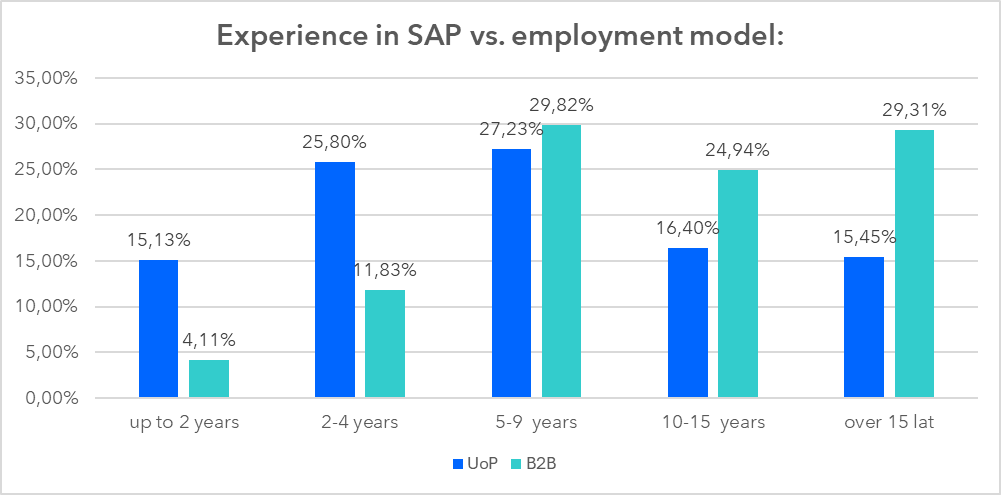
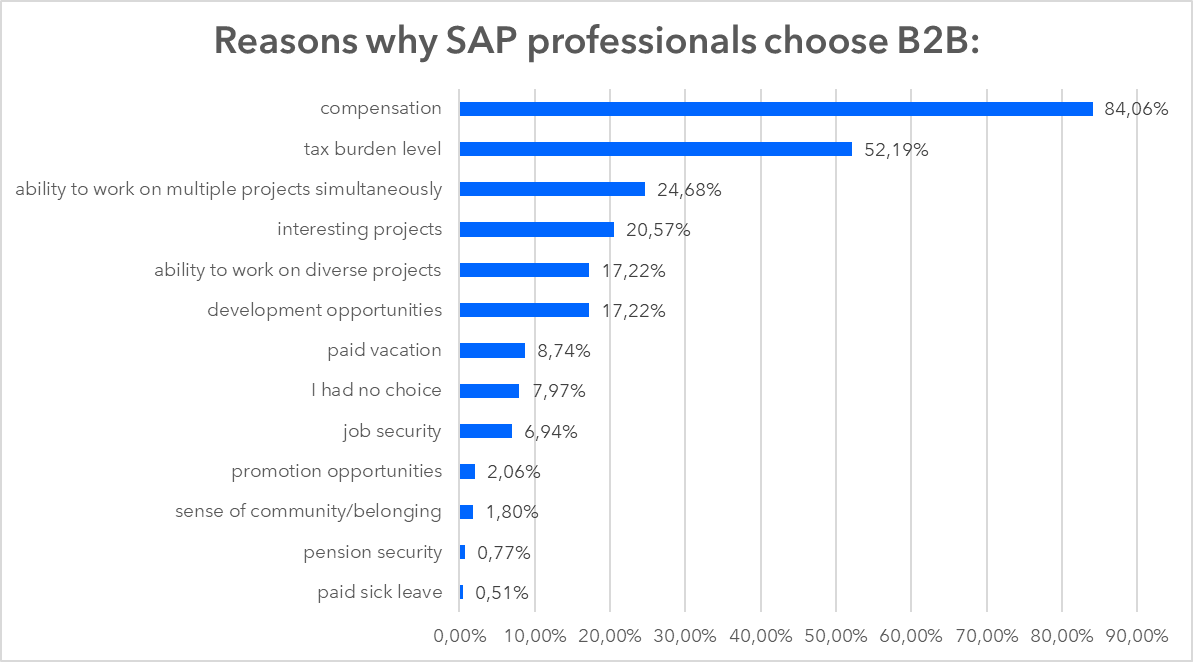
The main reason for this is take-home pay, but that is not the only factor. High labour costs and taxes in Poland are causing experienced specialists to give up their jobs. However, it is not just a matter of converting the amount from an employment contract into the benefits of self-employment. Working on a B2B basis opens up opportunities for candidates to provide services to more than one company, work part-time and access more complex, developmental projects. Employers also motivate them to do so: the rates for experienced consultants are so high that more and more companies are using their services for only a few days or hours a week. Their workload may be higher during key phases of projects, but this is not necessary during the preparation phase or after implementation.
Will changes in the law hinder access to SAP talent?
In short: no, as long as the company shapes its cooperation model appropriately.
SAP specialists work in the following ways:
• autonomously,
• task-based,
• project-based,
• often simultaneously for multiple clients,
• without the subordination typical of full-time employment.
This naturally fits the definition of a B2B service rather than an employment relationship.
The risk increases when a company:
• imposes fixed working hours,
• integrates the consultant into its structures,
• treats them like a line employee,
• evaluates them based on time rather than results.
This is not a B2B problem — it is a problem of an improperly constructed B2B contract.
Industry voice: SoDA warns of a sharp and real increase in labour costs
SoDA emphasises that the greatest threat associated with the new powers of the National Labour Inspectorate is a potential sharp increase in labour costs, which could particularly affect companies operating on a project basis. The organisation provides specific calculations: an average IT company that would have to convert approximately 30 B2B contracts into employment contracts would incur additional costs of PLN 1.8 million per year. Such a change could wipe out margins or even lead to operating losses, because in an industry where 70-90% of all expenses are personnel costs, even a moderate increase in burdens is a significant financial shock. SoDA points out that the regulation does not take into account the specific nature of project work or the preferences of specialists, which may lead to a brain drain abroad and long-term legal uncertainty. At the same time, the organisation calls for clarification of the regulations — clear criteria for distinguishing between B2B and employment relationships, uniform control procedures and ‘safe harbour’ protection mechanisms that would protect properly constructed contracts from the risk of discretionary reclassification.
A secure and more cost-effective model of cooperation? Outsourcing teams and specialists
For many companies, especially in the context of pressure from the National Labour Inspectorate, outsourcing SAP services is the solution. Why?
• the service relationship is clearly defined,
• the supplier assumes formal responsibilities and regulatory risk,
• the end company has stable access to expertise,
• it is easier to scale teams and respond to project changes,
• costs remain predictable.
This is the direction that large organisations are already choosing, reducing the number of direct B2B contracts. It is also a significantly lower cost than converting B2B to permanent employment. Professional agencies, such as Awareson, build their offer in such a way that candidates and teams are within the budget specified by the client, applying a fixed and clear margin for building the team and managing its work.
Body leasing as a cure-all?
The change in the PIP’s powers does not eliminate B2B cooperation, but it raises the bar — it requires companies to be more disciplined in terms of contracts and evidence. From the perspective of those employing IT/SAP specialists, this means additional administrative burdens and risks that do not directly result from operational needs, but from the regulatory environment.
Body leasing/outsourcing of SAP specialists eliminates a significant part of this risk, while securing access to scarce skills. That is why it is becoming the preferred model for supplementing teams in many organisations.
1. Clear service relationship
In body leasing, the supplier, not the client, is the party to the contract with the consultant. As a result, formal, tax and contractual obligations lie with the outsourcing company, and the National Labour Inspectorate does not analyse the client-consultant relationship. The risk of reclassifying the cooperation as full-time employment does not apply to the organisation implementing the SAP project.
2. Stable access to expertise despite changes in the law
SAP specialists, especially senior ones, will remain with B2B. Body leasing allows you to acquire their expertise without changing the preferred form of cooperation and without transferring legal risk to the client. This ensures that transformation projects remain continuous.
3. Predictable costs and no retroactive charges
In the outsourcing model, the client pays for the service at a fixed, transparent price. The risks associated with possible misclassification of the form of cooperation — including retroactive social security costs — are borne by the supplier. This increases the budgetary stability of SAP projects.
4. Scaling teams without staffing burdens
Body leasing eliminates the need for recruitment, onboarding, or HR support for consultants. Companies can quickly change the composition of their teams while maintaining the pace of project implementation without engaging additional HR resources.
5. Protection of the organisation in the event of an audit
With outsourcing, the consultant is not an employee of the client, and compliance documentation and contact with the Labour Inspectorate are the responsibility of the supplier. This significantly reduces the operational and reputational risk for the end organisation.
ARRANGE A FREE CONSULTATION WITH AN AWARESON BUSINESS ADVISOR
The PIP reform may introduce uncertainty, but it does not close the door to cooperation with SAP experts. However, it does close the door to vaguely constructed B2B relationships, which in practice reinforces the importance of models based on professional services. It is crucial to implement them with a trusted partner and on clear financial terms. The reform will certainly further polarise the SAP labour market, which is already clearly divided into permanent work at the end customer’s site — maintaining and developing the system — and contract work, focused on implementations and deeper modifications. Some consultants will certainly remain ‘loyal’ to permanent positions. A long-term commitment to an organisation, not only in terms of competence but also values, offers benefits such as security, belonging and the opportunity to build a company and relationships in the long term.
Awareson currently supports 115 of the largest international and Polish organisations in building SAP teams, both in the outsourcing model and in permanent recruitment, depending on the needs of the company and the team.

